
Core Design Pillars (#1): Exploration

When I began designing this game two years ago, (or rather finalising the design after years bounding around inside my head), the project would be bound by several core design pillars throughout development. The first:
Exploration: The Big One
Starflight 2 is where I drew my inspiration for what exploration means to me, and the experience I wish to deliver to players. That feeling of a "small ship VS a big universe". You against the void.
There are three layers of space in the game, two of which may be on the same "plain" if you will; the first two are the inner and outer star-system and the third "plain" is what's beyond in the wider sector... where can I go via the starmap? What's out there?

The inner system is intended to be safer, although not not completely safe. The outer system contains several unknowns and dangers.
The starmap itself reveals to your sensors information based on real data from what is happening in the system.
Radio signals, EM sigs, heat sources are all real data based on entities inside the sector, nothing is fake or ambient. The more ships in a sector the bigger the radio footprint.
Active combat in a sector might yield more heat sources, hotter ships...
The presence of spatial phenomena, wormholes, blackholes and such will yield higher readings in the EM band. So a large wormhole, with a strong gravity pull would read significantly higher.
The analysis of this data informs your decision...do I go there? Will a large blackhole swallow me on arrival? An unstable wormhole pull me in? Those are all real possibilities.

Wormholes: These entities can be stable, unstable or ancient. Stable generally means you're free to go through either side as you please. Unstable is largely the same but with a decay rate. Once an unstable WH collapses, you cannot traverse it without first stabilising it for travel. Ancient WH's lead to... more dangerous places tied to the game's central story.
Stable wormholes can open entirely new system's or short cuts across the sector.
Unstable wormholes take you beyond into unknown territory and unknown inhabitants and hazardous regions of space.
Some factions might pay big credits for information about these wormhole mappings.
Dark sectors: You could land in one of these sectors in some cases where the only light present is what you bring with you. Tread carefully.

All this culminates in the feeling of expeditionary type exploration. Venturing into the outer system requires being well equipped and able to defend yourself. Venturing into wormhole chains (yes they can chain to deeper holes) also requires you to be well equipped, or not, your choice.
Inside the INNER regions of a star system, if you are at least neutral to the owning race/faction, they will assist any request you make. Repairs, distress calls, resupply, but beyond a certain boundary they do not venture.
You have to consider your ship's fuel, spare parts for repairs, food/water for the crew, ammunition for your ship. While this mechanic is deep, it is not punishing! your crew will not go hungry every five minutes, it is not a micro-managing feature. Cast your thoughts to the era of tall ships searching for the North-west passage.
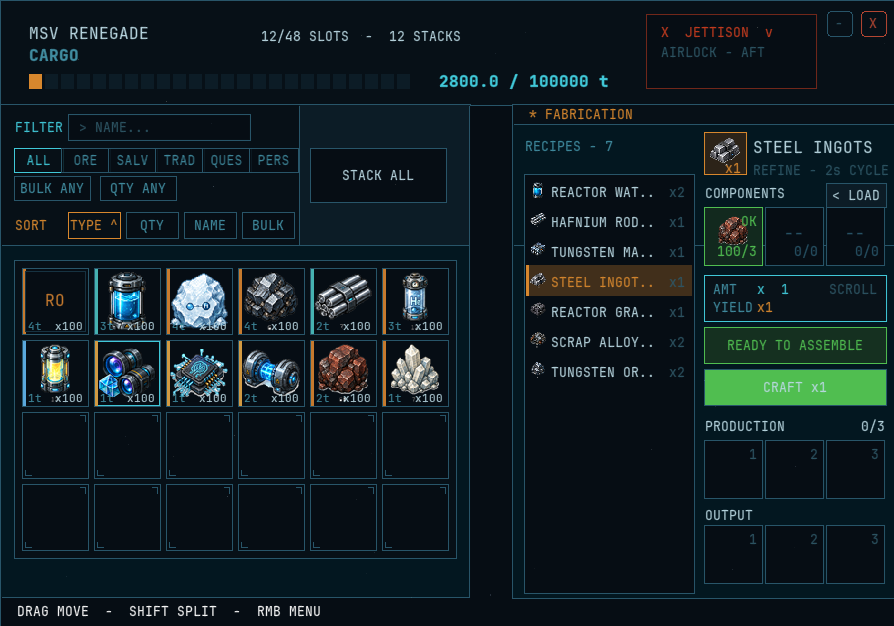
The final piece which supports this expeditionary type exploration: crafting. Your ship has the ability to craft recipes once you have the required raw materials. If you run low on fuel? There's always an asteroid or source material around to fill a hole, you just have to find it. For example water ice can be extracted from asteroids, and crafted into basic deuterium fuel cells.
Low on food or water? Find a temperate planet and send an away team to the planet in your support ship to gather possible food/water supplies.
Next will be pillar #2: The "Living, breathing world" as they say


Comments